
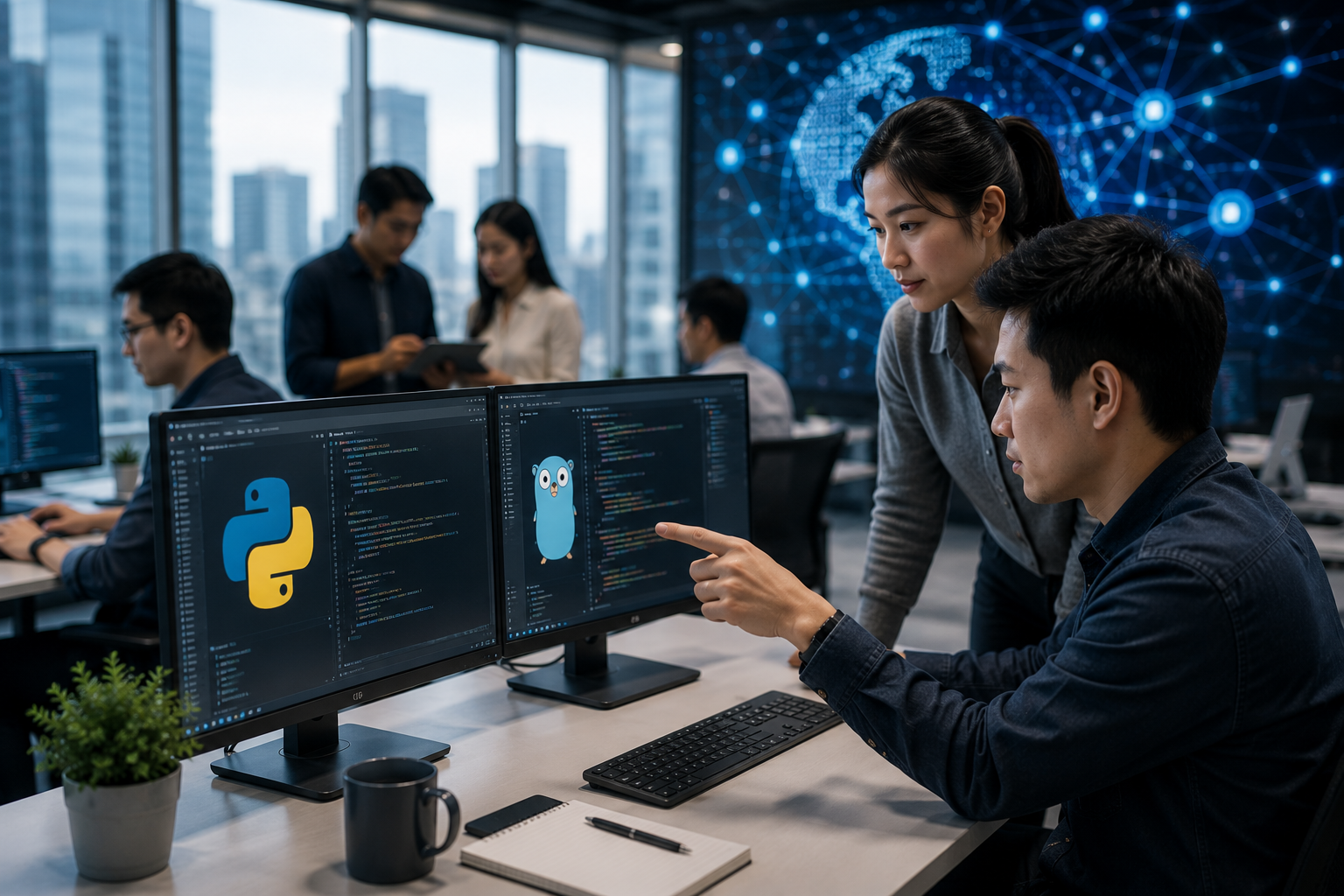
As digital transformation accelerates across industries, programming skills have become more than just a technical requirement—they are now a strategic business capability. Whether in banking, telecommunications, healthcare, manufacturing, or government, organizations are increasingly seeking software professionals who can build scalable applications, automate business processes, and support data-driven innovation.
Among today’s most valuable programming languages, Golang (Go) and Python have emerged as two of the most important technologies shaping modern software development. As demand for digital services continues to grow, companies are recognizing that providing fundamental training in these languages is no longer an option—it is an investment in future competitiveness.
Why Golang and Python?
Although both languages are widely adopted, they serve different but complementary purposes. Python has become the preferred language for artificial intelligence (AI), machine learning, data analytics, automation, and rapid application development. Its simplicity allows developers to prototype ideas quickly while supporting some of the world’s most advanced AI and data science ecosystems.
Golang, developed to build highly efficient and scalable systems, has become a popular choice for cloud computing, backend services, APIs, distributed systems, and microservices. Its performance and reliability make it particularly attractive for organizations operating large-scale digital platforms.
Together, these two languages provide a strong technical foundation for modern software engineering. Organizations are modernizing their technology environments at an unprecedented pace.
Cloud-native applications, API integration, automation platforms, digital banking, e-commerce systems, and enterprise analytics all require software that is reliable, scalable, and secure.
Developers with a solid understanding of Python and Golang are better equipped to contribute to these initiatives from the earliest stages of digital transformation.
Rather than relying solely on external vendors, companies that invest in internal technical capabilities can accelerate innovation while maintaining greater control over their technology roadmap.
Preparing for the AI Era
The rapid adoption of Artificial Intelligence has dramatically increased demand for Python skills. Many AI frameworks, including machine learning libraries, data processing tools, and automation platforms, are built around Python. IT professionals with strong Python fundamentals can more easily adopt AI technologies, develop intelligent applications, and automate repetitive business processes.
Meanwhile, Golang is becoming increasingly important for building the high-performance backend services that support AI applications at scale, including APIs, cloud platforms, and distributed computing environments.
Together, these programming languages create a practical foundation for organizations preparing for the next generation of intelligent business systems. Fundamental programming training delivers benefits beyond technical knowledge.
Developers who understand core programming concepts are more capable of writing maintainable code, solving complex problems, collaborating effectively within development teams, and adapting to new technologies throughout their careers.
Modern software development increasingly relies on Agile methodologies, DevOps practices, containerization, cloud deployment, and continuous integration pipelines. Strong programming fundamentals allow employees to adopt these practices more efficiently while improving overall software quality and project delivery.
Organizations ultimately benefit from faster development cycles, reduced technical debt, and more reliable digital services.
Building Internal Digital Capability
One of the biggest challenges facing technology-driven organizations is the global shortage of experienced software engineers. Competition for skilled developers continues to intensify as businesses across every industry expand their digital capabilities.
Rather than relying exclusively on recruitment, many organizations are investing in structured technical training programs that develop talent from within. Fundamental Golang and Python training helps employees build practical skills while creating clear career pathways into software engineering, cloud computing, automation, AI, and backend development.
Developing internal talent also strengthens employee engagement and improves long-term workforce resilience. Effective programming education is not simply about memorizing language syntax.
The most successful training programs emphasize problem-solving, software architecture, debugging techniques, version control, testing, API development, database integration, and collaborative software engineering practices.
Hands-on projects, real business case studies, and practical coding exercises help participants gain confidence while applying new skills to real organizational challenges.
This practical approach ensures that learning translates directly into measurable business value.
Strategic Investment for Every Industry
While financial institutions have been among the earliest adopters of Golang and Python, the demand for these skills extends far beyond banking.
Manufacturing companies are automating production systems. Healthcare providers are analyzing medical data. Telecommunications companies are optimizing network performance. Retail businesses are building intelligent customer experiences. Government agencies are accelerating digital public services.
Across sectors, organizations share a common need: technology professionals who can build modern, scalable, and secure digital solutions. As businesses continue embracing cloud computing, artificial intelligence, automation, and data-driven decision-making, programming skills will become increasingly valuable across the workforce.
Companies that invest early in developing foundational Golang and Python capabilities will be better positioned to innovate, reduce dependency on external resources, and respond more quickly to changing market demands.
Digital transformation is ultimately driven by people. By equipping employees with modern programming skills, organizations are not only strengthening their technical capabilities—they are building a workforce ready to shape the future of business.
In an increasingly digital economy, learning Golang and Python is no longer simply about writing code. It is about empowering people to create solutions, accelerate innovation, and deliver lasting competitive advantage.
Editor: Rachmat Adhani (Business Development Manager Ocean Innovation)